

When choosing hardwood flooring, the surface is often the first thing people notice. The wood species, grain pattern, color, and finish all contribute to the look of a floor. But the appearance is only one part of the story.
The construction beneath the surface plays an equally important role in how an engineered hardwood floor performs over time.
Unlike solid hardwood, engineered hardwood is built with multiple layers, each serving a specific purpose. Understanding these layers can help homeowners, designers, and flooring professionals make more informed decisions when evaluating flooring products.
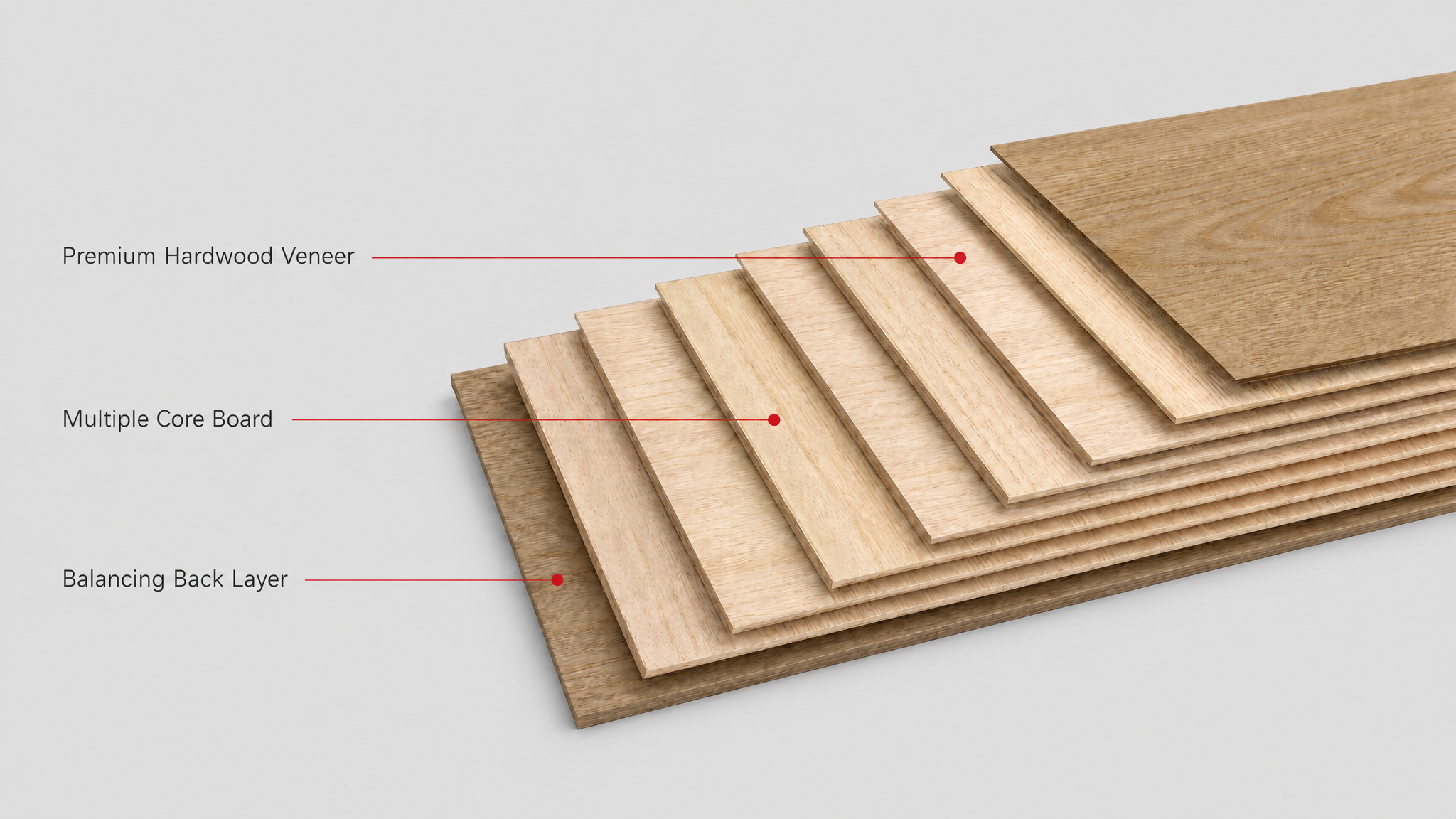
1. Premium Hardwood Veneer
The top layer is a premium hardwood veneer, made from real hardwood.
This layer provides the authentic appearance and natural character associated with hardwood flooring. The species, grain, color variation, and surface finish all contribute to the overall aesthetic of the floor.
Because the veneer is real wood, each plank can have its own natural variation, helping create a floor with a more authentic and distinctive appearance.
2. Multiple Core Board
Beneath the hardwood veneer is the multiple core board.
This layered wood construction forms the structural foundation of the engineered plank. Unlike a solid piece of lumber, the multiple-layer construction is designed to provide greater dimensional stability by distributing the movement of individual wood layers.
This is one of the key differences between engineered hardwood and traditional solid hardwood construction.
The core structure also gives manufacturers greater flexibility in developing different plank formats, thicknesses, and installation solutions according to the needs of different flooring applications.
3. Balancing Back Layer
At the bottom is the balancing back layer.
This layer works together with the upper layers to help maintain balance within the flooring structure. Since wood naturally responds to changes in moisture and environmental conditions, maintaining a well-balanced multi-layer construction is an important part of engineered hardwood design.
The result is a flooring structure designed to provide a stable foundation beneath the real hardwood surface.
Why Does Construction Matter?
A hardwood floor is more than the surface you see.
When evaluating engineered hardwood, it is important to look beyond color and finish and consider how the entire plank is constructed.
A well-designed structure brings together:
- Real hardwood beauty through the premium hardwood veneer
- Structural support through the multiple core board
- Balanced construction through the back layer
- Dimensional stability through the engineered multi-layer design
These elements work together to create a flooring product that combines the natural character of real wood with a carefully engineered structure.
Look Beyond the Surface
The quality of engineered hardwood is not determined by its appearance alone. The materials, layer configuration, and overall construction all contribute to the performance of the finished product.
When evaluating engineered hardwood, look beyond the surface — because what is underneath matters just as much.